

Family Cruises
Cruise Safety With Kids: The Fears Parents Have but Rarely Talk About

Recent cruise-industry headlines have brought some uncomfortable safety concerns back into the spotlight.
One investigation doesn’t define cruising as a whole, but it did get us thinking about something you don’t see many travel advisors talking about: the fears parents sometimes have when cruising with their kids.
And honestly, I understand why. Nobody wants to scare families away from a vacation they’re excited about.
But I’m not only a travel advisor. I’m also a mom who cruises with my own kids, and I know how quickly a parent’s brain can go from this is going to be amazing to worrying about kids getting separated, teenagers having too much freedom, strangers approaching them, trafficking, overboard accidents, or how safe the kids clubs really are.
We’ve had some of those worries ourselves.
One reason this has been on our minds is Operation Tidal Wave, an ongoing federal operation involving cruise ship crew members. In a September 25 announcement, U.S. Customs and Border Protection said officers at the Port of Boston had removed 87 foreign crew members from cruise ships as part of an initiative targeting the possession and distribution of child sexual abuse material (CSAM) and child sexual exploitation material (CSEM).
That does not mean 87 crew members were suddenly criminally arrested in one day. The 87 figure refers to crew members removed through enforcement actions over time, and individual cases have had different outcomes. CBP has also said there was no indication that the material uncovered in the Boston operation was connected to children aboard the cruise ships.
Still, when you’re a parent, a story like that makes you think.
So let’s talk about the safety questions parents actually have.
Is Cruising With Kids Safe?
We love cruising with our kids, and we plan to keep doing it.
But a cruise ship is still a place filled with thousands of people you don’t know. Accidents and crime don’t disappear just because everyone is on vacation.
The goal isn’t to be afraid. It’s to use the same common sense you would at a hotel, resort, mall, or anywhere else your kids have some independence.
Have a Plan in Case Your Child Gets Separated
Modern cruise ships can be enormous, so make sure everyone knows what to do if someone gets separated.
- Choose a meeting place. Pick somewhere public, easy to recognize, and easy to find without a phone.
- Make sure kids know the cabin number. They should know it if they need help, but not casually share it.
- Give younger kids simple instructions. Go to the meeting spot or find an identifiable crew member instead of wandering the ship.
- Take a quick photo before heading out. If you ever need to describe what your child was wearing, you’ll have it.
Hopefully that photo’s only purpose is documenting what everyone looked like before sunscreen, wind, and unlimited soft-serve ice cream happened to them.
Giving Teenagers More Freedom Onboard
This is a big one for us because we’re at the age where our kids naturally want more independence.
That freedom can be part of what makes cruising fun for teenagers, but it should come with clear rules.
Our Basic Rules for Teens Onboard
- Use the buddy system when possible.
- Don’t enter another passenger’s cabin.
- Check in at agreed times.
- Message us if plans change.
- Follow the curfew we set.
- Leave if something feels wrong and find us, ship security, or another trusted adult.
The exact rules depend on age and maturity. What matters is deciding them before the trip instead of negotiating them at midnight.
Personal Boundaries Still Matter on Vacation
Meeting new people can be one of the best parts of traveling, but normal boundaries still apply.
Kids and teens should tell you if someone is:
- Asking them to keep secrets
- Trying to isolate them from family or friends
- Inviting them into a private cabin
- Offering alcohol or drugs
- Asking for inappropriate or sexual photos
- Making sexual comments
- Pressuring them into physical contact
- Giving gifts or attention that comes with secrecy
- Trying to move conversations into private or disappearing-message apps
- Making them uncomfortable for any reason
That applies whether the person is another passenger, another teenager, or someone working onboard.
The overwhelming majority of cruise employees are simply doing their jobs professionally, but a uniform doesn’t replace personal boundaries.
Kids should know they’re allowed to leave an uncomfortable situation without worrying about being rude.
What About Human Trafficking?
This is one of the scariest topics for parents and one of the most misunderstood online.
A lot of people hear human trafficking and picture a stranger grabbing a child from a crowded place and disappearing.
DHS guidance explains that this Hollywood-style kidnapping scenario is not how trafficking typically begins. Exploitation can develop gradually through grooming, manipulation, coercion, secrecy, and gaining someone’s trust. Human trafficking also does not require someone to be transported or taken across a border.
So the more useful conversation with kids isn’t simply: “Watch out or somebody might take you.”
It’s helping them recognize when something isn’t right.
- Adults should not ask them for sexual images.
- People online are not always who they say they are.
- Gifts or special attention should never come with secrecy.
- Nobody should be asking them to hide a relationship, conversation, photo, gift, or interaction from their parents.
- They can come to you when something feels wrong without automatically being blamed or punished.
Those conversations matter far beyond a cruise ship.
What About Falling Overboard?
Open decks and balconies can send a parent’s imagination to some pretty dark places.
Cruise ships use railings and barriers designed to prevent accidental falls, but children still need clear rules around them.
They should never:
- Sit or stand on railings
- Climb railings
- Lean dangerously over the edge
- Use furniture to gain extra height
- Horseplay near open decks
- Climb on balcony furniture
Younger children should be closely supervised on balconies, and balcony doors should be secured when appropriate.
Some parents also have the frightening thought of someone intentionally hurting a child near an open deck. While serious violent incidents can occur in almost any travel environment, this isn’t something families should board a ship expecting to happen.
The useful response is the same basic safety plan you’re already teaching: stay in appropriate public areas, use the buddy system, avoid going into private cabins, maintain check-ins, and leave immediately if someone or something makes you uncomfortable.
Are Kids Clubs Safe?
Kids clubs are one of the best parts of family cruising.
The kids have fun. The parents briefly remember what uninterrupted conversations feel like.
Before leaving your child, understand how that cruise line’s youth program works.
Find out:
- Who can sign your child in and out
- Whether older children can sign themselves out
- How parents are contacted
- Whether kids leave the youth area for activities
- What the bathroom procedures are
- How allergies or medical needs are handled
- What happens if your child wants to leave
- What security procedures are used
Policies vary by cruise line and age group, so pay particular attention to self-checkout privileges for tweens and teens.
And afterward, ask your child what they did, who they met, and whether anything made them uncomfortable.
Not like you’re conducting an interrogation under a swinging light bulb.
Just stay involved.
Cabin Safety
A few simple rules go a long way. The U.S. State Department also advises cruise travelers to keep cabin and balcony doors locked.
- Keep the cabin door closed and locked.
- Don’t prop it open.
- Don’t casually share your cabin number.
- Don’t let younger kids open the door without knowing who is outside.
- Keep balcony doors secured when appropriate.
- Avoid publicly posting that your children are alone in a specific part of the ship.
That last one sounds obvious.
The internet continues to prove otherwise.
Talk to Older Kids About Drinks
For older teenagers:
- Don’t accept drinks from strangers.
- Don’t leave a drink unattended and come back to it.
- Don’t drink something if you don’t know what’s in it.
- If a friend suddenly seems unusually confused, sick, or impaired, get an adult immediately.
That isn’t just a cruise lesson.
It’s a life lesson.
Safety in Port
Once you leave the ship, you’re in an unfamiliar environment with different transportation, neighborhoods, and sometimes different laws or languages.
Before getting off:
- Make sure everyone knows the all-aboard time.
- Have a meeting plan if someone gets separated.
- Use reputable transportation and excursion providers.
- Keep phones charged when possible.
- Don’t flash large amounts of cash.
- Be careful about sharing personal information.
- Know how you’re getting back to the ship.
- Make sure older kids know what to do if they become separated from the family.
If you’re booking an independent excursion, research the company before you go.
Saving twenty dollars becomes considerably less impressive when nobody knows where you are.
What If Something Actually Happens?
If your child tells you someone behaved inappropriately, take it seriously.
If something concerning happens onboard:
- Get your child somewhere safe.
- Contact ship security.
- Write down what happened while the details are fresh.
- Save messages, photos, or other evidence.
- Ask for medical attention if needed.
- Ask how the incident is being documented.
- Contact law enforcement when appropriate.
The FBI advises passengers who witness or experience serious crimes onboard to report them to ship security immediately.
Most importantly, listen to your child.
Don’t dismiss what they’re saying because the person involved seemed nice, and don’t avoid reporting something because you’re worried about ruining the vacation.
Vacations can be replaced.
Your child’s safety can’t.
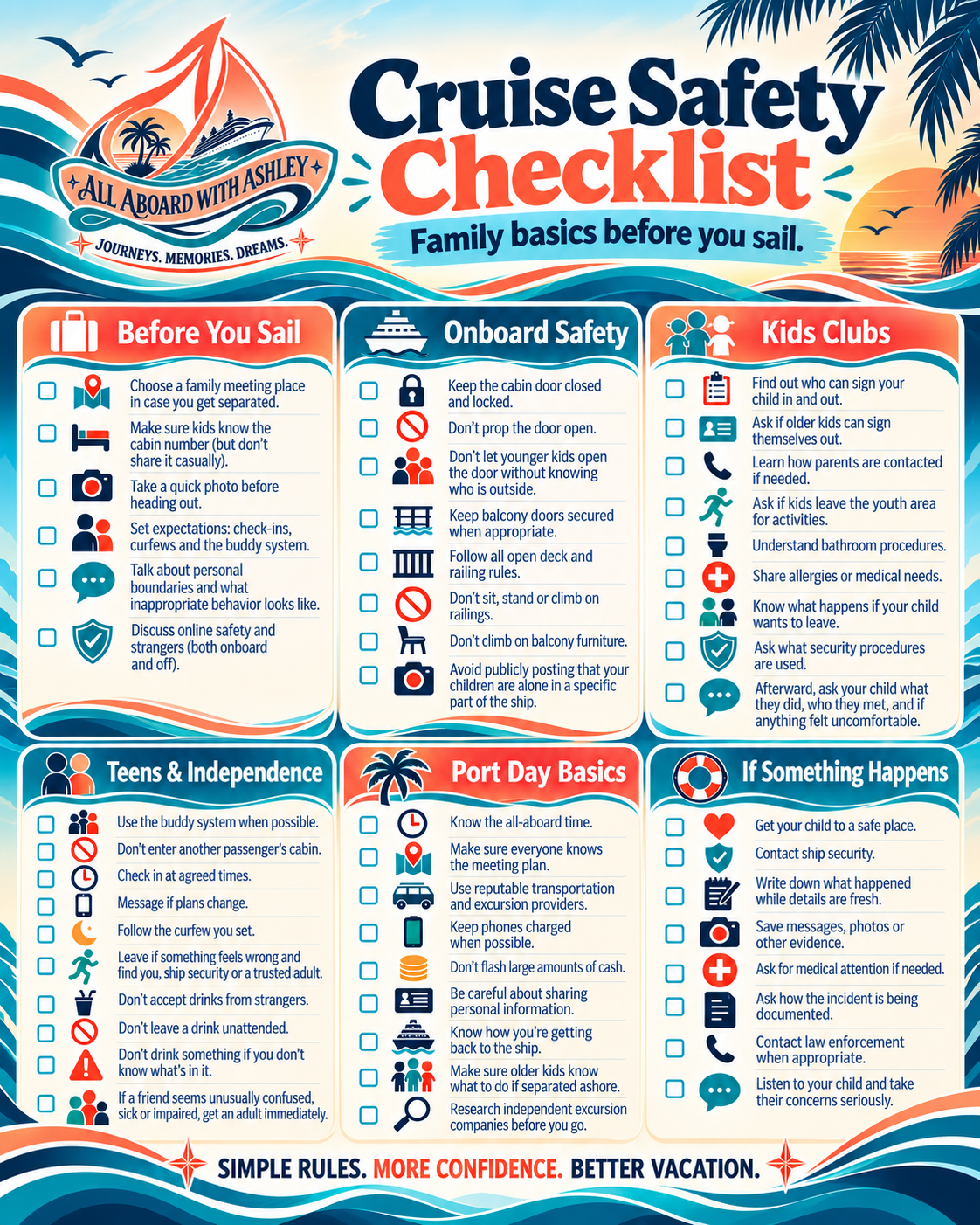
Family Cruise Safety Checklist
Before you sail, cover six basics as a family:
- Have a separation plan: choose a meeting place and make sure everyone knows what to do if they get lost.
- Set expectations: agree on check-ins, curfews, the buddy system, and where kids are allowed to go.
- Talk about boundaries: make sure kids know what inappropriate behavior looks like and that they can always come to you.
- Review onboard safety: cover cabins, balconies, open decks, drinks, and kids-club rules.
- Plan for port days: know the all-aboard time, transportation plan, and what to do if separated ashore.
- Know how to get help: make sure everyone knows when to find a crew member or contact ship security.
You don’t need to hover over your kids every second.
You just want everyone to know the plan before they need it.
The Bottom Line
Travel advisors spend a lot of time talking about why you should take the vacation.
And I love that part of what I do.
But there’s also value in talking about the things parents quietly worry about before they ever step onboard.
As our kids have gotten older, those safety conversations have changed too.
When they’re little, you worry about keeping them close.
When they’re teenagers, you’re trying to figure out how much independence is enough without giving yourself a heart attack.
There’s no perfect system, and every child is different.
A few clear rules, open conversations, and a basic plan can give everyone more confidence to enjoy the vacation.
Then you can get back to the considerably more important family arguments.
Like who gets the balcony bed.
Journeys. Memories. Dreams.
Ashley